INTRODUCTORY NOTE
The Sacred Lineage: Grandson of the Prophet and Son of Fatima-tu-Zahrah(SAA)
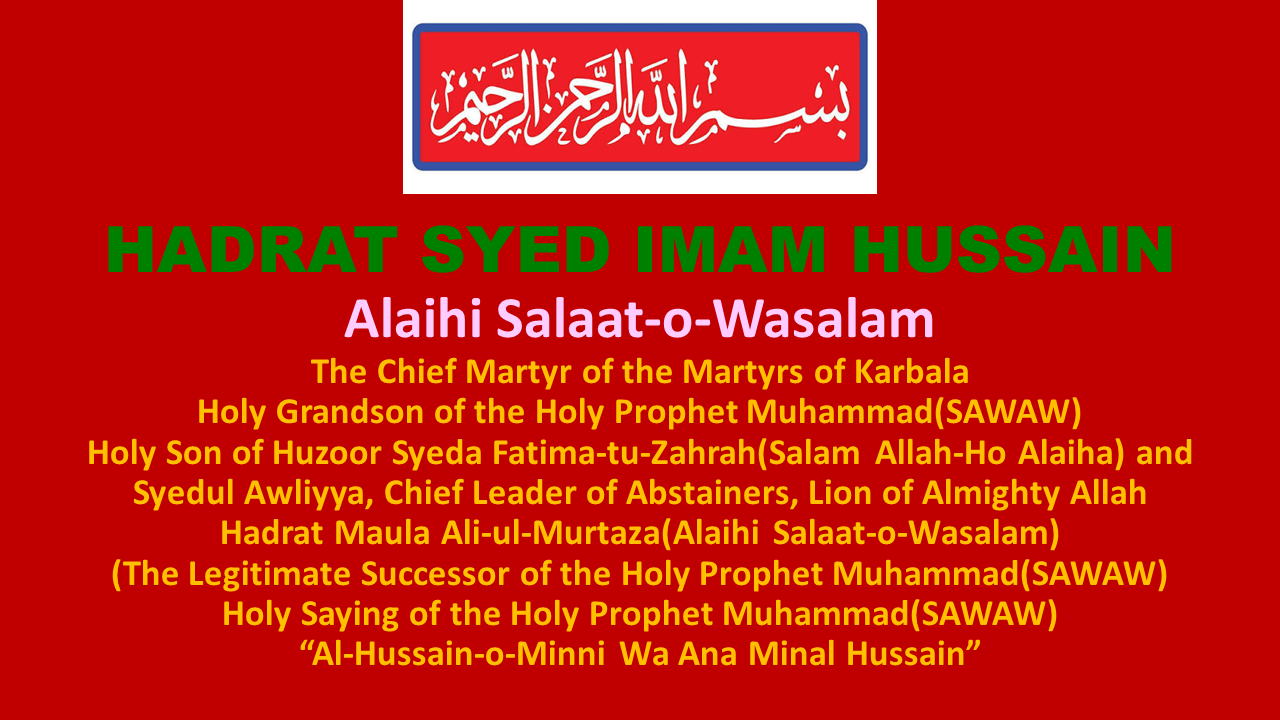
Hadrat Syed Imam Hussain (ASWS) occupies a position of unparalleled sanctity in the annals of Islamic history, a station that is intrinsically linked to his noble lineage as the grandson of the Holy Prophet Muhammad (SAWAW). He was born in the blessed city of Medina on the 3rd of Sha’ban in the year 4 AH, into the very household that the Quran itself has declared to be purified . His father was Imam Ali ibn Abi Talib (AS), the cousin of the Prophet and the epitome of courage and wisdom, while his mother was Huzoor Syeda Fatima-tu-Zahrah (Salam Allah-Ho Alaiha), the beloved daughter of the Prophet. This lineage is not merely one of blood but of spiritual inheritance, as Imam Hussain grew up in the lap of the Holy Prophet, absorbing the divine wisdom and prophetic character that would later define his life. The Prophet Muhammad (SAWAW) expressed his profound love for his grandsons, declaring them to be the “Masters of the Youths of Paradise,” a title that already in his childhood marked the exalted spiritual station of Hussain ibn Ali . His mother, Fatima Zahra, herself a paragon of virtue and piety, nurtured in him the principles of justice and unwavering faith, ensuring that he became a living embodiment of the moral and spiritual values of Islam.
The Prophetic Announcement and Spiritual Station
The divine dignity of Imam Hussain (ASWS) was acknowledged not only on earth but in the heavens, signified by a beautiful tradition regarding the angel Futrus. Upon the birth of Hussain, the Archangel Gabriel was commanded by Allah to congratulate the Holy Prophet. On his descent, Gabriel encountered the angel Futrus, who had been banished from heaven. Gabriel carried the angel to the Prophet, and the Prophet instructed him to touch the newborn child, upon which the angel’s wings were instantly restored, and he ascended praising the Prophet and his grandson . This tradition powerfully illustrates the immense spiritual power and sanctity inherent in the person of Imam Hussain from the very moment of his birth. His dignity was further solidified by his participation in the historic event of Mubahala, where the Prophet, following divine revelation, took with him his “sons”—meaning Hasan and Hussain—to invoke Allah’s curse upon the Christians who disputed the truth of Islam . This event not only established the supreme spiritual status of the Ahl al-Bayt but also affirmed that the progeny of the Prophet through Fatima Zahra are the inheritors of divine grace and leadership, a status that Imam Hussain carried throughout his life.
The Stand Against the Tyranny of Yazid: The Dignity of Truth
The supreme manifestation of Imam Hussain’s (ASWS) dignity and sanctity came in his principled stand against the illegitimate and tyrannical rule of Yazid ibn Mu’awiyah. Upon the death of Mu’awiyah, Yazid—a man characterized in historical and religious sources for his impiety, licentiousness, and deviation from Islamic norms—demanded allegiance from Imam Hussain . For the Imam, paying allegiance to Yazid was not a mere political choice; it was a matter of faith. He recognized that submitting to Yazid would be akin to endorsing corruption and destroying the very foundations of the religion his grandfather had established . His famous statement, “We are the household of the Prophet… Yazid, on the other hand, is a reprobate, a drinker of wine and a killer of the innocent,” encapsulates the moral and spiritual chasm that made any compromise impossible . The Imam chose to rise against this oppression not out of a desire for worldly power, but to “seek reform in the nation of my grandfather,” to promote virtue and prevent vice, a mission that transcended personal ambition and was rooted in the prophetic duty to safeguard the faith . His declaration, “Never to humiliation!” became the clarion call of a movement that prioritized the eternal dignity of truth over the transient security of submission .
The Tragic Incident of Karbala: The Sanctuary of Sacrifice
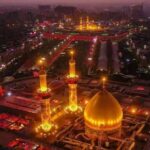
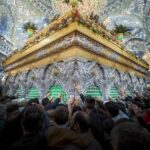
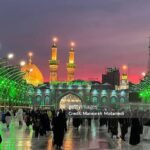
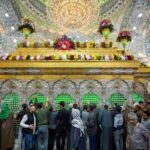
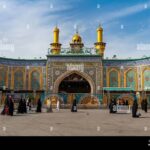
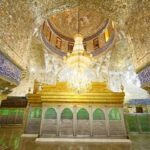
The tragic events of Karbala unfolded when Imam Hussain (ASWS), having received numerous invitations from the people of Kufa, journeyed towards Iraq, only to be intercepted by the massive army of Yazid. On the 2nd of Muharram, 61 AH, the Imam and his small entourage of family members and loyal companions arrived at the desert plain of Karbala, where they were forced to encamp and were brutally cut off from the life-giving waters of the Euphrates . For days, the camp of the Prophet’s grandson, which included innocent women and children, suffered the agonies of thirst under the scorching sun, a testament to the sheer tyranny they faced. On the 10th of Muharram, Ashura, the battle commenced. Despite being vastly outnumbered—with only a small band of 72 faithful companions against an army of thousands—the Imam and his followers fought with unmatched bravery and resolve . One by one, his companions, his brothers, and his sons, including his valiant brother Hazrat Abbas and his son Ali Akbar, fell on the battlefield, each sacrificing their lives for the cause of truth. The tragedy reached its heart-wrenching climax when Imam Hussain, himself wounded and exhausted, brought his six-month-old infant, Ali Asghar, and pleaded for water for the dying baby. In a barbaric act that defies comprehension, a deadly poisoned arrow was shot, pinning the infant’s neck to the arm of his helpless father . The final martyrdom of Imam Hussain himself, after witnessing the annihilation of his entire camp, sealed his sacrifice in history as a victory of dignity, faith, and unwavering resolve over oppression and tyranny.
The Eternal Legacy: Reviver of Islam
The tragedy of Karbala is not merely an event of the past but a living reality that continues to shape the spiritual consciousness of millions. The sacrifice of Imam Hussain (ASWS) ensured the revival of Islam, protecting the religion from the total distortion and destruction intended by the Umayyad regime . As the saying goes, “Every day is Ashura and every land is Karbala,” because the stand for truth and justice is a timeless and universal principle. Imam Hussain’s movement is a symbol of the perpetual struggle against falsehood and injustice, a beacon of hope for the oppressed and a guide for those seeking to live with dignity and honor . His martyrdom was the ultimate act of worship, a profound demonstration that the preservation of the principles of faith is more valuable than life itself. He taught humanity that dignity is not found in surrendering to power but in standing firm on the side of righteousness, no matter the cost. The fresh and enduring remembrance of Imam Hussain (ASWS), his message of sacrifice, patience, and unwavering faith, continues to inspire freedom movements and the struggle against oppression across the globe, confirming that he and his companions won the spiritual battle and left an indelible mark on the history of human civilization.